Why Every AI Platform Should Steal ZAI's Off-Peak Scheduling Model

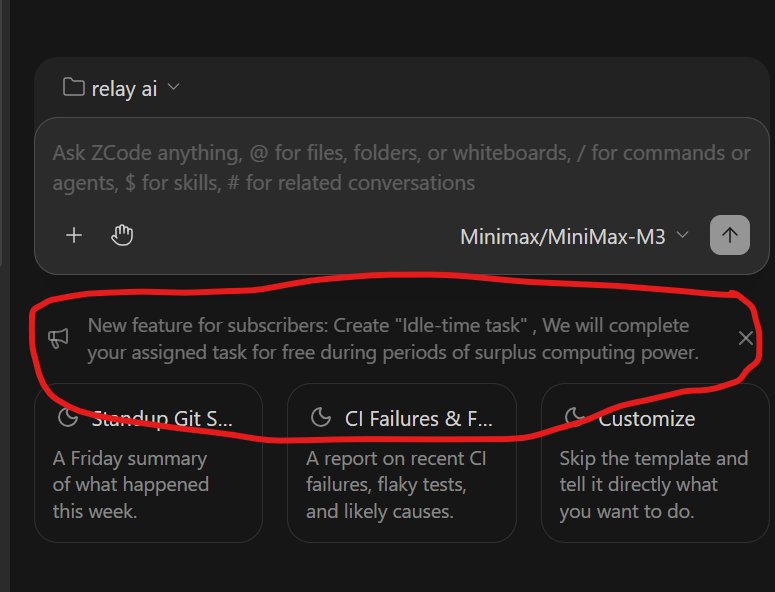
I ran a task on ZAI last week that cost me roughly $0.
Not a rounding error. Not a promotional credit. It ran entirely during their off-peak hours window, when their servers are sitting idle, and they let me push compute through at basically no cost.
I sat with that for a second.

What's actually happening
ZAI has peak hours — Monday to Friday, 2PM to 6PM Singapore time. That's when demand is highest and compute is expensive. Outside that window, their servers are running under capacity. So they pass the savings on: off-peak usage is 50% of the standard credit rate. Run your tasks after hours and you cut your bill in half automatically.
But it goes further. They also have this concept of background tasks that run when idle capacity is available — tasks you can queue up and forget about, that execute essentially for free because they're filling gaps in the schedule rather than competing for peak resources.
"By making full use of the off-peak benefit, you can save up to 92% compared with calling GLM-5.2 through the standard on-demand usage API." — ZAI Documentation
Ninety-two percent.
Why this is genius
Most AI platforms bill you the same rate regardless of when you run a task. Peak hour, middle of the night, doesn't matter — same price. That model is simple, but it's wasteful in two ways:
On the platform side: servers sit idle overnight and on weekends. All that compute is paid for but not used.
On the consumer side: you're paying peak prices even when you don't need real-time results. If you're scheduling a report, running an analysis, or generating content that doesn't need to be done in the next 30 minutes, why are you paying peak rates for it?
ZAI's model aligns both incentives. The platform fills its idle capacity with scheduled work. The consumer gets dramatically lower prices. Nobody's being cheated.
The infrastructure argument
This matters beyond just pricing. If scheduled, non-urgent tasks can be pushed entirely into off-peak windows, you're reducing the total compute infrastructure a platform needs to run. Less peak-hour demand means fewer GPUs running hot at the same time. Less electricity consumed during peak windows. Less waste.
At scale, this becomes a genuine environmental and cost argument for the entire industry. Spreading workload across time means the same compute resources do more with less.
A practical example
I have a weekly report I need generated. It doesn't need to be ready at 3PM on Friday — it needs to be ready by Monday morning. Under a flat-rate model, I'd run it whenever and pay the same. Under ZAI's model, I queue it for Saturday morning, it runs on idle compute, and it costs me a fraction of what I'd pay to have it done in real-time.
The report is the same quality. The turnaround is slightly longer. But the price difference is not trivial — it's the difference between "this is a tool I can afford to use daily" and "I'm watching my credits burn."
Every platform should do this
The interesting thing is how obvious this is in retrospect. Airlines do it. Hotels do it. Any capacity-limited service with variable demand does it — off-peak pricing is decades old. AI compute is just late to the party.
If you're running any AI platform: build this. Off-peak windows, idle-capacity scheduling, background task queues. Your power users will find them immediately. Your casual users will discover they can afford to schedule things they previously couldn't. Your infrastructure costs flatten out. It's a genuine win-win.
If you're using AI platforms: look for this. The difference between peak and off-peak pricing can be 50% or more. If your task can wait, make it wait.
Filed under: AI Automation, Founder Notes