OpenAI Just Made GPT-5.6 80% Cheaper — And Almost Nobody Noticed
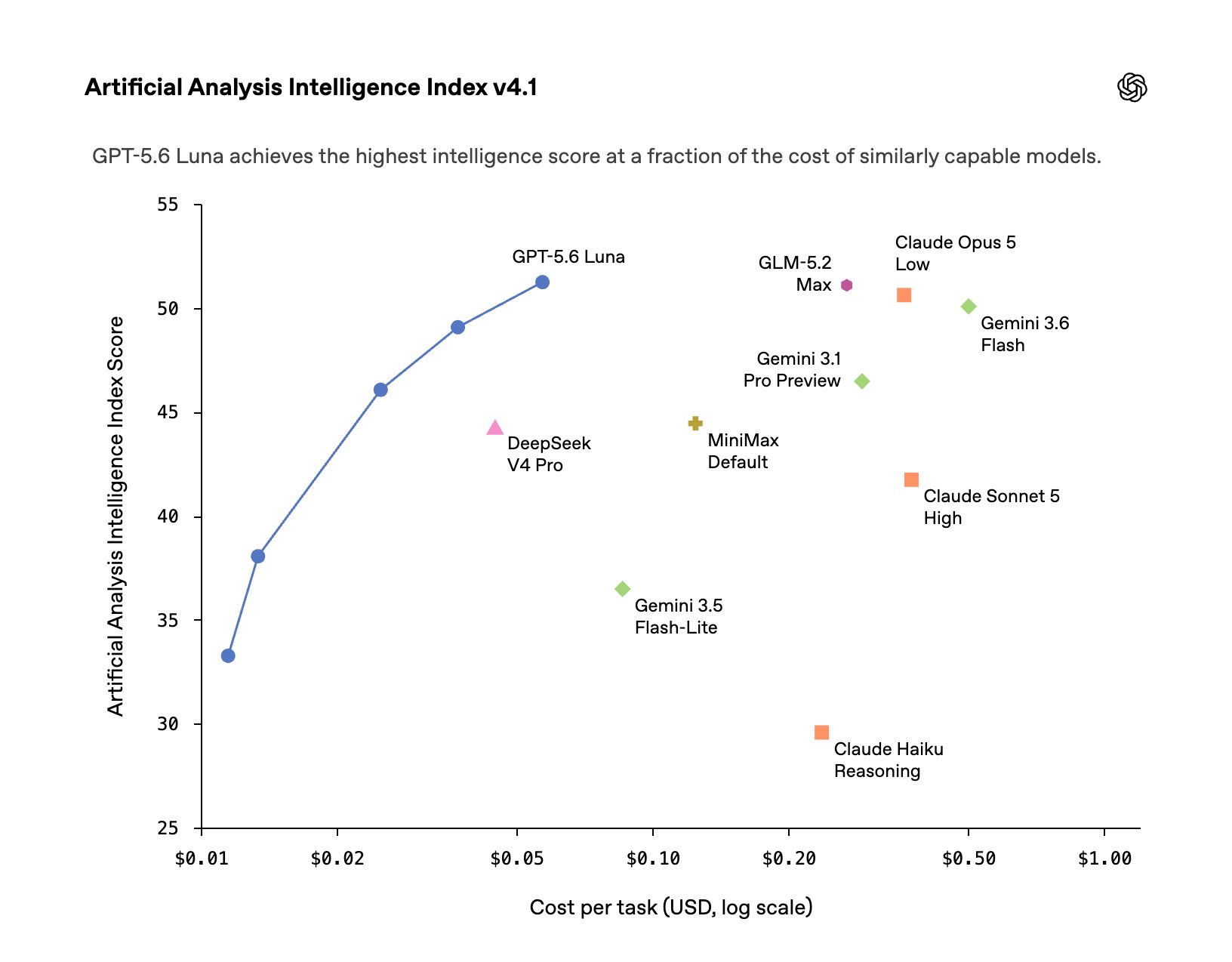
OpenAI quietly dropped prices today. GPT-5.6 Luna — 80% cheaper. GPT-5.6 Terra — 20% cheaper. GPT-5.6 Sol — faster option added to the API.
If you blinked you missed it.
And I think that's a mistake — because this isn't a promotion. It's a pattern. And the pattern tells you something important about where AI is going.
What Actually Changed
The announcement had the usual corporate framing — "committed to pushing the model frontier across cost efficiency, capability, and speed" — but the numbers underneath it are significant:
GPT-5.6 Luna: 80% price reduction. This is the big one. Luna was already positioned as the more cost-efficient option. Now it's dramatically cheaper. For context: if you were paying $10/month on Codex for Luna-powered tasks, you're now paying $2 for the same usage.
GPT-5.6 Terra: 20% reduction. More modest but still real. Terra sits between Luna and Sol in the capability hierarchy. The 20% cut brings it closer to Luna's cost territory.
GPT-5.6 Sol: faster API option. Not a price cut on Sol itself — but a faster version at the same price point. More capability for the same cost.
The kicker in OpenAI's own words: "Luna and Terra's lower prices are reflected in how usage is counted in Codex and ChatGPT Work, so your usage goes further."
That last line is the one that should get your attention if you're running Codex as your primary coding environment.
Why 80% Matters More Than It Sounds
Price cuts in AI aren't linear. When a model drops 80%, things that weren't economically viable become viable. Workflows you were rationing become unlimited. Entire categories of automation that required you to watch your usage meter stop requiring that.
An 80% price reduction means the break-even point for AI-assisted work shifts dramatically. If you were previously calculating whether a given task was worth burning $0.50 of your Codex budget — that task now costs $0.10. The calculus changes.
For heavy users — the ones who have been watching the 5-hour window anxiously, the ones who know exactly how many tokens they've burned this week — Luna being 80% cheaper means the usage constraints that have been quietly shaping your workflow matter less. You can do more research. You can run more experiments. You can let the model do more of the work instead of doing it yourself to conserve budget.
This Is Not Generosity — It's a Business Decision
OpenAI isn't being nice. They're responding to competitive pressure.
The open source ecosystem has been closing the gap — DeepSeek, Llama, Mistral — all driving down what it costs to run capable models. When open source models are delivering 90% of GPT-5's capability at a fraction of the cost, OpenAI has to make their own models more accessible or watch usage migrate.
The 80% Luna cut is OpenAI saying: we know the economics are changing, and we're going to move first.
That competition is good. It's the reason you get 80% price cuts instead of 5% ones. The frontier model's moat isn't as wide as it was two years ago, and OpenAI knows it.
The Faster Sol Point Is Being Overlooked
Most of the commentary on today's announcement focused on the Luna cut. The Sol point deserves more attention.
GPT-5.6 Sol is OpenAI's reasoning model — the one that does the slow, careful thinking for complex problems. A faster version at the same price means you get the same quality output in less time for the same cost. That matters in two specific ways:
One: if you're using Sol for real-time coding assistance, faster means more responsive. The model can iterate on your code quicker. You spend less time waiting.
Two: faster at the same price effectively means more capable per dollar. You're getting through more reasoning steps in the same time window. That compounds.
What This Means for Your Stack
If you've been running a hybrid approach — open source for cost-sensitive tasks, GPT-5 for high-priority work — today's prices mean the crossover point just moved. Tasks you were offloading to open source models because GPT-5 was too expensive might now be worth running on Luna.
The practical implication: audit your Codex usage. Look at what you're running on Sol versus Luna versus Terra. If Luna is doing work it could handle, move it there and your budget stretches further. If Terra is your default mid-tier option, check whether Luna at its new price point now makes more sense.
The Codex window is still a constraint — but the cost-per-token inside that window just dropped significantly. That's real.
The Trend Line
Here's what I keep coming back to:
Every six months, the same conversation happens. AI gets significantly cheaper. The previous "too expensive" threshold gets revised downward. Capabilities that required a enterprise budget last year run on a $20/month subscription today.
OpenAI's 80% Luna cut is the latest example. Six months from now, there will be another price cut. Maybe from OpenAI, maybe from a competitor. The direction is consistent: AI gets cheaper, AI gets faster, the gap between frontier and accessible narrows.
The question isn't whether this continues. It does. The question is whether you're building your workflows to take advantage of the trend — or whether you're still rationing usage based on last year's prices.
Use the window.