Your AI-made song can't go on Tidal. AI-assisted can.
If you make music with AI, one streaming service just drew a line through the middle of it. On November 24, Tidal said it will start blocking AI music on December 9. Songs generated entirely with AI will be removed. Music where AI helped will still be allowed.
This post covers what was reported, what it does not say, and how to think about it if AI is part of how you or your clients make audio.
What was reported
The details below come from MacRumors, which published the story on November 24. Tidal's own X account also posted a headline saying the service is "Deleting, Rejecting, and Banning Fully AI-Generated Music." I could read that headline but not the full post, so everything else here is as MacRumors reports it.
- Tidal plans to start blocking AI music on December 9.
- Any track generated entirely with AI will be removed from the platform, and Tidal will reject AI songs in the future.
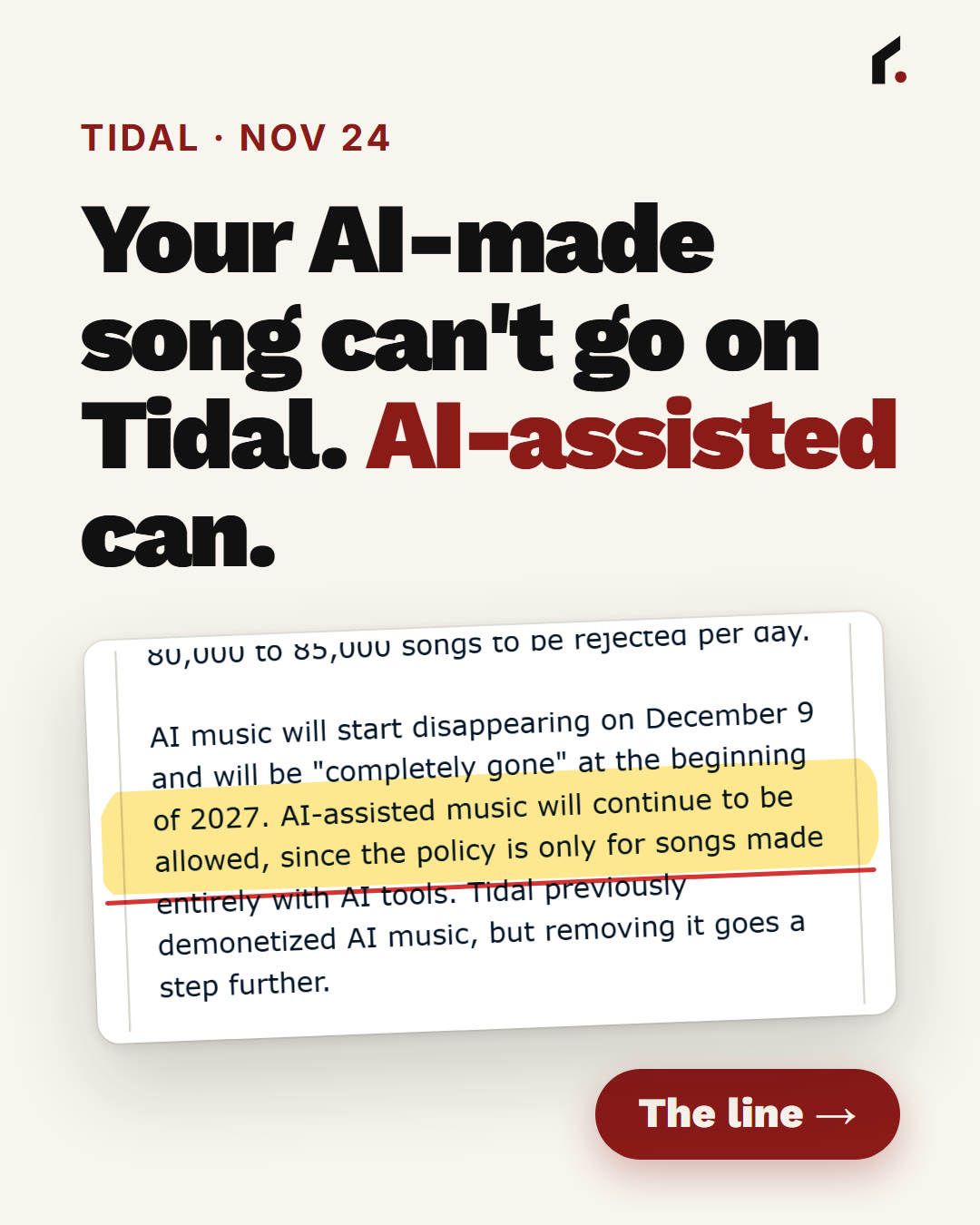
- AI music will start disappearing on December 9 and will be "completely gone" at the beginning of 2027.
- AI-assisted music will continue to be allowed, since the policy is only for songs made entirely with AI tools.
- Tidal previously demonetized AI music. Removing it goes a step further.
The numbers Tidal gave
MacRumors quotes Tidal lead Robert Andersen on two figures. He said 43 percent of tracks uploaded in the last 90 days have been flagged as AI-generated. He also said 96 percent of AI songs get zero plays, and that Tidal believes the move will "resonate with both artists and listeners alike."
Read those two numbers together. A large share of what is being uploaded is AI, and almost none of it is being listened to. That is the case Tidal is making for removing it. These are Tidal's own figures, relayed by one outlet, and I have not seen the underlying data. MacRumors and other coverage also differ on exactly how many tracks will be deleted, so I left that number out.
The line that matters: entirely AI versus AI-assisted
The headline version of this story is "Tidal bans AI music." The accurate version is narrower. The policy is for songs made entirely with AI tools. AI-assisted music is allowed.
If you make music, that distinction is the whole story. A track a tool produced start to finish is on one side. A track where a person wrote, played, sang or edited and used AI for part of the work is on the other. What the report does not tell us is where exactly Tidal draws the boundary in between. MacRumors does not say how Tidal will tell the two apart, and I have not found a Tidal page that spells it out. Until there is one, assume the boundary is a judgment call that Tidal makes.
What Apple Music is doing instead
The same article compares Tidal with Apple Music. Apple has not banned AI songs. It introduced AI Transparency Tags earlier this year and relies on labels and distributors to say when AI has been used. In August Apple said tracks "materially generated using AI" must carry a "Made With AI" label.
In April, Apple Music VP Oliver Schusser said more than a third of monthly uploads to Apple Music are 100 percent AI-generated. He also said AI music made up less than 0.5 percent of actual listening.
So two large services see the same pattern, lots of AI uploads and very little listening, and respond in different ways. One removes it. The other labels it.
What this means for a business that uses AI audio
This is not only a story for musicians. Plenty of agencies and service businesses use AI for background tracks, jingles, hold music and video soundtracks. A few practical points, all of them reading of the facts above and not advice from Tidal:
- Streaming is one place audio ends up. Tidal's rule is about its own catalog, so it does not change what you can use in a video or an ad.
- If you plan to distribute tracks to streaming services, check the policy of each one. They now differ.
- Keep a record of how a track was made, which tools, and what a person did. If a platform ever asks, that record is what separates "assisted" from "entirely AI."
My read
I think this is the start of a question platforms will ask more often: how much of this was human? Tidal answered with removal and Apple answered with labels, but both are really asking the same thing. Whether the line sits at "entirely AI" or somewhere stricter later is not something anyone has said, so treat that as my opinion and not a prediction from either company.
What to do this week
- If you release music, look at how your tracks are made and be ready to describe it.
- If you distribute through a service, read its current AI policy before December 9.
- If you only use AI audio inside videos and ads, nothing here changes your day, but it is worth knowing where the platforms are heading.
Does your work use AI audio, and would you be comfortable explaining exactly what a person did on it?